Saying No, Offering Better
The discipline behind saying no the right way.

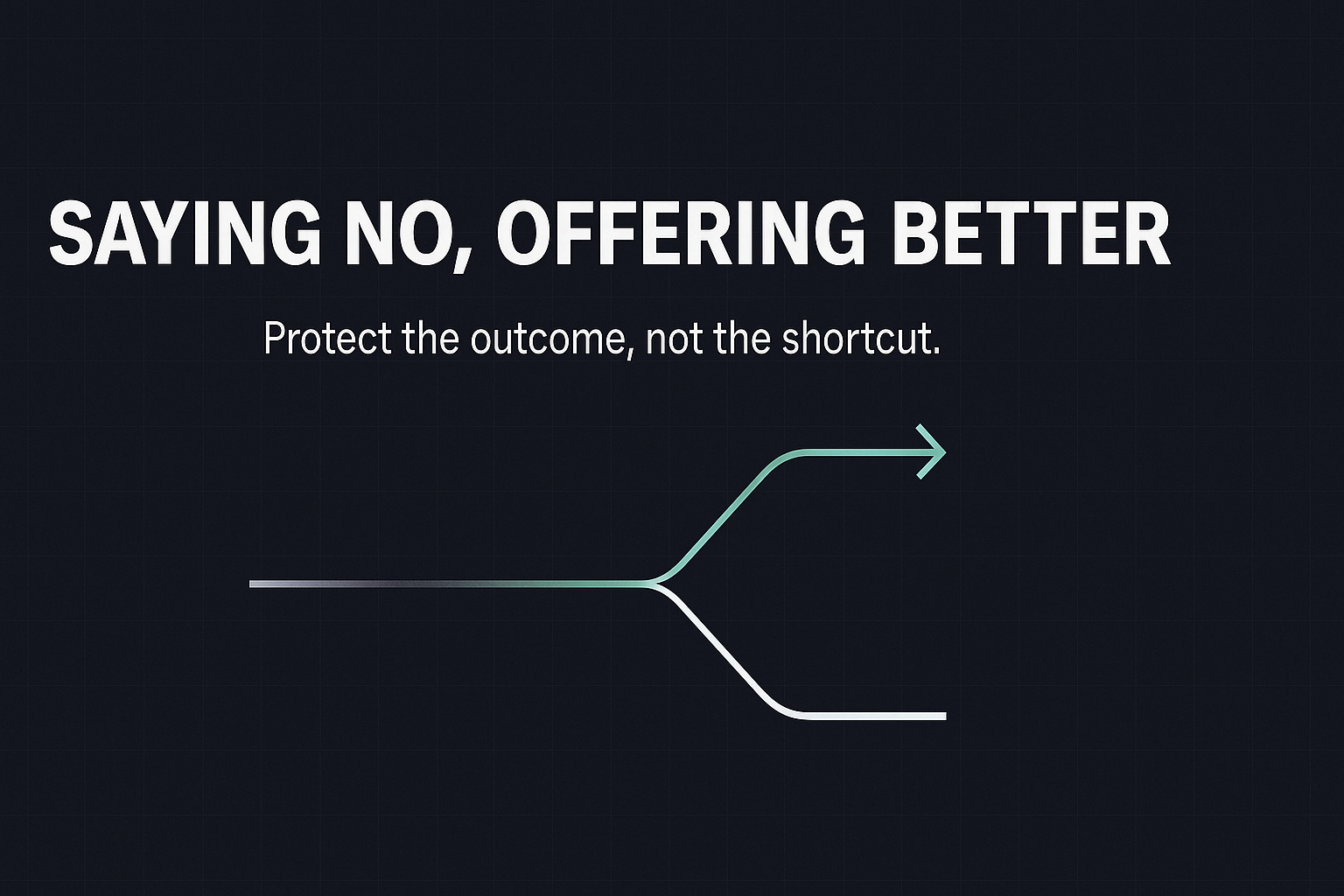
Every team eventually reaches the same moment.
Someone proposes a shortcut that looks harmless, maybe even helpful.
It promises speed.
It promises momentum.
It promises to “just get it done.”
But shortcuts in software have a predictable shape.
They start small, stay quiet, and surface later as drift, mismatched data, broken flows, or late-night debugging sessions.
A senior engineer’s job is not to forbid change.
It’s to see the cost early and redirect before the team steps into something expensive.
This is where the ability to say no — and offer something better — becomes essential.
Why saying no matters
A plain “no” often creates friction.
It can feel authoritative or dismissive.
That’s not the goal.
The real goal is to protect the outcome:
a clear flow, a stable contract, predictable behavior, and a release the team can trust.
Saying no is part of that discipline, but only if it comes with reasoning and an actionable alternative.
Otherwise, it becomes a roadblock instead of a contribution.
A useful pattern emerges
Over time, you start noticing that most risky suggestions fall into a few categories:
changes that break under realistic load
changes that bypass the contract or create drift
changes that remove observability and make failures opaque
changes that feel fast but insert ambiguity into the system
In each case, the correction is not to shut the idea down.
The correction is to replace the risky path with one that preserves intent but avoids long-term damage.
A good “no” always comes with a better route.
Three scripts that consistently work
1. No, because the system won’t hold under load.
A safer path is batching, throttling, or reshaping the flow.**
This addresses the concern directly: the proposed change doesn’t fail logically, it fails operationally.
Pointing to load boundaries keeps the discussion grounded in real constraints, not opinions.
2. No, because this creates contract drift.
Let’s evolve the schema instead of patching around it.**
Drift is one of the most expensive forms of technical debt.
The fix—formalizing the shape—avoids confusion across layers and teams.
This is not slowing down; it’s keeping the system coherent.
3. No, because we won’t be able to observe this.
Let’s add one metric or log and then ship.**
Speed isn’t the issue.
The issue is blindness.
A small observability anchor turns a risky change into a safe one, without slowing delivery.
The purpose of a good no
A good no doesn’t block progress.
It keeps the path intact so progress continues without hidden costs.
It does three things:
aligns the team on the real constraints
maintains the integrity of contracts and flows
supports the original goal with a safer execution plan
This is what separates obstruction from stewardship.
The team moves faster when someone is protecting the direction, not just the timeline.
The principle behind the scripts
Behind every effective “no” is the same idea:
Decline the shortcut, protect the outcome, and offer a path the team can trust.
It’s not a managerial skill or a personality trait.
It’s part of technical practice — the quiet discipline that keeps systems stable and teams calm.
When engineers learn to say no this way, they reduce rework, avoid drift, and keep delivery predictable.
That’s the real impact of offering better.